Every day, people in your city type searches like “dentist near me”, “CA for GST filing” or “best maths classes in Kothrud” into Google. These people are ready to act. The only question is whether your business appears when they search. If you have ever wondered what is SEO and whether it really matters for a small business, this guide is for you.
I like to explain SEO with a simple sugarcane-juice analogy. In this guide I cover what SEO means, how search engines work, the three parts of SEO, a starter checklist and an honest answer to “How long will it take?”
What is SEO?
SEO, or Search Engine Optimisation, is the work of making your website easier for search engines to find, understand and trust, so it appears in the unpaid results when your customers search.
Split the phrase into its two parts.
- Search engine: the system, such as Google or Bing, that finds web pages, stores them and decides which ones to show for each search.
- Optimisation: the work of making your website easier for that system to find, understand and trust, so it appears for the searches your customers actually make.
SEO is about the organic results, the ones you do not pay for per click. It is not about tricking Google; it is about becoming the most useful, credible answer to a real person’s question.
How does the sugarcane-juice analogy explain SEO?
Your website is like sugarcane: one pass through the machine gives a little juice, but repeated, careful passes extract far more. SEO is the process of improving the same website again and again so it yields more visibility, enquiries and trust.
Think of a roadside sugarcane-juice stall. The vendor does not pass the cane through the machine once. He folds it and runs it through again and again until every drop is out.
Many small businesses pay for a website, put it online and never touch it again. That site gives only a little juice. SEO is the process of running the same website through the machine properly: a clearer page for each service, better titles, faster loading, genuine reviews, useful answers. Each pass extracts more value from an asset you already own.
How do search engines work?
Every search engine does three basic jobs: it crawls the web to discover pages, indexes them to understand what each is about, and ranks them when someone searches. Your job is to make each of those steps easy.
- Crawling: automated programs, often called bots or spiders, discover pages by following links and reading sitemaps.
- Indexing: the search engine stores those pages and tries to understand what each one is about.
- Ranking: when someone searches, it chooses which indexed pages are most relevant and useful, and in what order.
The history is short. Archie, launched in 1990 to index file names on public servers, is often described as the first search engine. In the mid-1990s Yahoo began as a hand-built directory, and engines such as AltaVista indexed the full text of pages. Google, founded in 1998, changed the game by treating links from other sites as a kind of vote, so that trusted pages rose to the top. Today Google is, by most published measures, by far India’s most used search engine, and it now shows AI-generated answers too. I cover that shift in SEO for AI search.
What are the three parts of SEO?
SEO has three parts: technical SEO (can Google reach and read your site?), on-page SEO (does each page clearly answer what people search?) and off-page or local SEO (does the wider web trust you?). A small business needs all three.
1. Technical SEO
Can Google reach your website, load it and read it? Technical SEO covers mobile-friendliness, page speed, a secure HTTPS connection, no broken pages, a clean site structure and an XML sitemap. Most customers find you on a phone, so a slow mobile site quietly loses enquiries. Google Search Console, a free tool, flags many of these problems.
2. On-page SEO
This is the content and structure of each page. Does every core service have its own page? Does each page have a clear title tag, a helpful meta description and sensible headings? Most importantly, does it use the words your customers actually use? A clinic might write “root canal treatment”, while patients search “tooth pain treatment near me”. Good on-page SEO answers real questions in plain language and links related pages together.
3. Off-page and local SEO
This is your reputation outside your own website: links from relevant, trustworthy sites, mentions in local news or associations, listings in directories and, above all for local businesses, your Google Business Profile. Google has said that local results are based mainly on relevance, distance and prominence. Reviews, ratings and consistent name, address and phone details across the web all contribute to that prominence. My guide to Google Business Profile ranking explains the local side step by step.
How do you find the words your customers search for?
Start with your customers’ own language: the questions they ask on the phone, the suggestions Google shows as you type, and the searches already bringing visitors in Search Console. You do not need paid tools to begin.
- Ask your front desk: note the exact words customers use when they call or message, for example “fees for spoken English class” rather than “communication skills programme”.
- Use Google’s own suggestions: type your main service and city into Google and note the autocomplete suggestions and the “People also ask” questions.
- Check Search Console: once connected, the Performance report shows the searches for which your pages already appear.
- Group by intent: put searches that mean the same thing into one group, and give each group one page rather than many thin ones.
The Juice Machine checklist: SEO for small businesses
The Juice Machine checklist is a ten-step starter plan that any owner or team member can work through over a few weeks, covering set-up, pages, reputation and a monthly review.
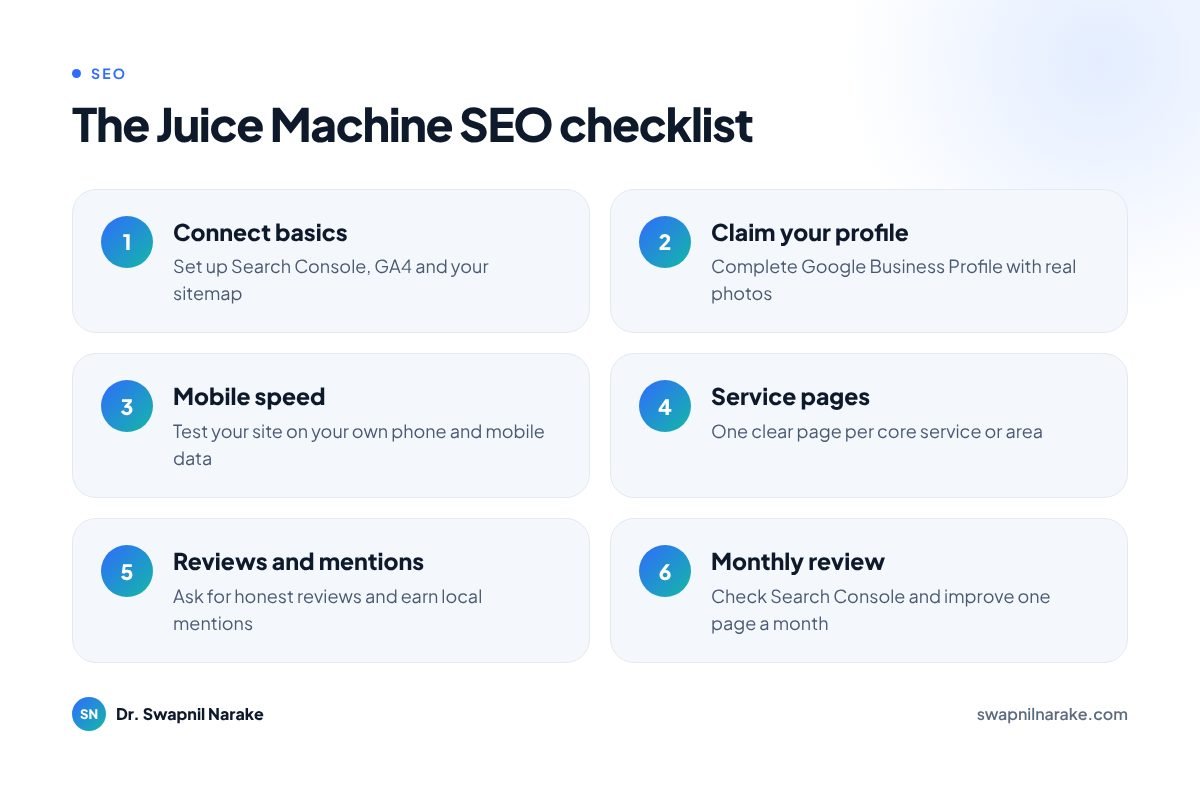
- Connect the basics: set up Google Search Console and Google Analytics 4, and submit your sitemap.
- Claim your Google Business Profile: complete every field, choose accurate categories and add real photos.
- Test on your own phone: open your site on mobile data. If it feels slow to you, it feels worse to a customer.
- One page per core service: and, where relevant, one per area you serve, each written for the person searching.
- Write unique titles and descriptions: every page should clearly say what it offers and where.
- List 20 customer questions: ask your front desk what people ask on the phone, then answer them on your site.
- Keep contact details consistent: the same business name, address, phone and WhatsApp number everywhere.
- Ask for reviews: request honest Google reviews from happy customers, and reply to every review, positive or negative.
- Earn local mentions: relevant directories, trade associations, local partners and community events.
- Review monthly: check Search Console for the searches that bring visitors, and publish or improve one useful page each month.
For the wider picture in Marathi, see my guide on digital marketing for small businesses.
A worked example: one service page for a coaching class
Here is how a hypothetical coaching class could turn a single generic “Courses” page into an SEO-friendly service page for its Class 10 maths batch.
- Title tag: “Class 10 Maths Coaching in Kothrud, Pune | Small Batches” instead of “Courses”.
- Opening paragraph: who the course is for, which board it covers, batch timings and the area served, in plain words.
- Useful details: syllabus outline, batch size, fees or fee range, test schedule and how doubts are handled.
- Answers to real questions: a short FAQ built from what parents actually ask, such as “Is there a demo lecture?” and “Are weekend batches available?”
- Trust signals: teacher qualifications, genuine reviews with permission and the address with a map.
- Clear next step: a call button and a WhatsApp link that work properly on mobile.
Repeat this for each core course and you have a website that matches what parents search, instead of one page trying to rank for everything.
Common SEO mistakes small businesses make
The most common mistakes are treating the website as a one-time project, writing for the business rather than the customer, and chasing shortcuts.
- All services on one page: Google cannot tell which search that page should answer.
- Keyword stuffing: repeating “best dentist Pune” ten times reads badly and does not help.
- Copying text from other sites: duplicate content gives Google no reason to prefer you.
- Buying cheap links: low-quality link packages can harm more than help.
- Ignoring mobile speed: heavy images and pop-ups push impatient visitors away.
- Not tracking anything: without Search Console and Google Analytics 4, you cannot tell what is working.
How long does SEO take?
Expect months, not days. Google’s own guidance on hiring an SEO mentions that it often takes four months to a year to implement improvements and then see the benefit. Less competitive local searches may move sooner; crowded, high-value searches usually take longer.
Unlike ads, SEO compounds. When you stop paying for ads, the traffic stops; good pages and a strong reputation keep working long after the effort is made. In my own work, growing organic website traffic roughly 10x, from about 20K to 200K monthly visits, came from steady SEO and content work, not a single trick. That is why I treat SEO as a system rather than a campaign, an idea I explain in Systems over Motivation.
Key takeaways
- SEO means making your website easier for search engines to find, understand and trust, so you appear in unpaid results.
- Like a sugarcane machine, SEO extracts more value from a website you already own.
- Search engines crawl, index and rank pages; your job is to make each step easy.
- Work on all three parts: technical, on-page, and off-page or local SEO.
- Expect months of steady work, but results compound over time.
FAQs
Is SEO free?
You do not pay Google for organic rankings, but SEO costs time, effort and sometimes professional help. Think of it as an investment in an asset rather than a free channel.
Can I do SEO for my business myself?
Yes, the basics in the checklist above are very doable for an owner or a team member. For technical fixes or competitive markets, expert support usually saves time and mistakes.
Is SEO still worth it now that AI answers appear in search?
Yes. AI answers still draw on websites that are clear, credible and well structured. The fundamentals of good SEO also make your business easier for AI tools to understand and cite.
What is the difference between SEO and Google Ads?
Google Ads places paid ads above or beside results, and the traffic stops when you stop paying. SEO earns unpaid, organic positions that take longer to build but keep working over time. Many businesses use both.
Do I need a blog for SEO?
Not necessarily. Clear service pages, a strong Google Business Profile and answers to common questions matter more for most small businesses. A blog helps when you can publish genuinely useful articles regularly.
Understanding what is SEO is the first step; turning it into steady enquiries is a matter of patient, systematic work. For consultation, keynotes or academic engagements on SEO and digital growth, feel free to get in touch.