
Almost every week someone tells me that AI “does not work” for their business. When I ask how they used it, the story is usually the same: they typed one question, copied the first answer, found it generic or slightly wrong, and concluded that AI is overhyped. That is not a failure of the technology. It is a failure of method. If you want to get real value from AI, you have to stop treating it like a search box and start treating it like a new member of your team.
This post explains the four steps I teach in my workshops, with a worked example, practical uses in CA offices, coaching classes and clinics, and the mistakes to avoid. If you prefer Marathi, you can read this in Marathi.
Why doesn’t “ask once, then blame AI” work?
It fails because AI can only work with the instructions and information you give it. A one-line request gets an average, generic answer, and accepting it without checking means you never catch its mistakes.
AI assistants generate answers from what you provide. When you give very little, they fill the gaps with the most common, average response. That is why a request such as “write a post for my clinic” returns something that could belong to any clinic anywhere in the world.
There is a second problem. AI can sound confident even when it is wrong, quoting an outdated rule or inventing a believable detail. If you accept the first answer, you never get the chance to catch these mistakes.
What does it mean to treat AI like a new team member?
It means briefing AI the way you would brief a bright new junior: explain the role and context, correct the first draft and check the work before it reaches a customer.
Imagine a new junior joins your office on Monday. You would not hand them a file and say “do the needful” with no explanation. You would explain their role, your clients and the format you expect, correct their first draft, and check the work yourself before it reaches a client.
AI deserves the same treatment. It is fast and capable, but on day one it knows nothing about your business, your customers or your standards. Once you see it this way, frustration turns into a process you can repeat and teach.
The New Team Member Method: four steps to better answers
The New Team Member Method has four steps: give AI a role, give it your business context, give feedback on its drafts and check the final answer yourself. Follow all four whenever the task matters.
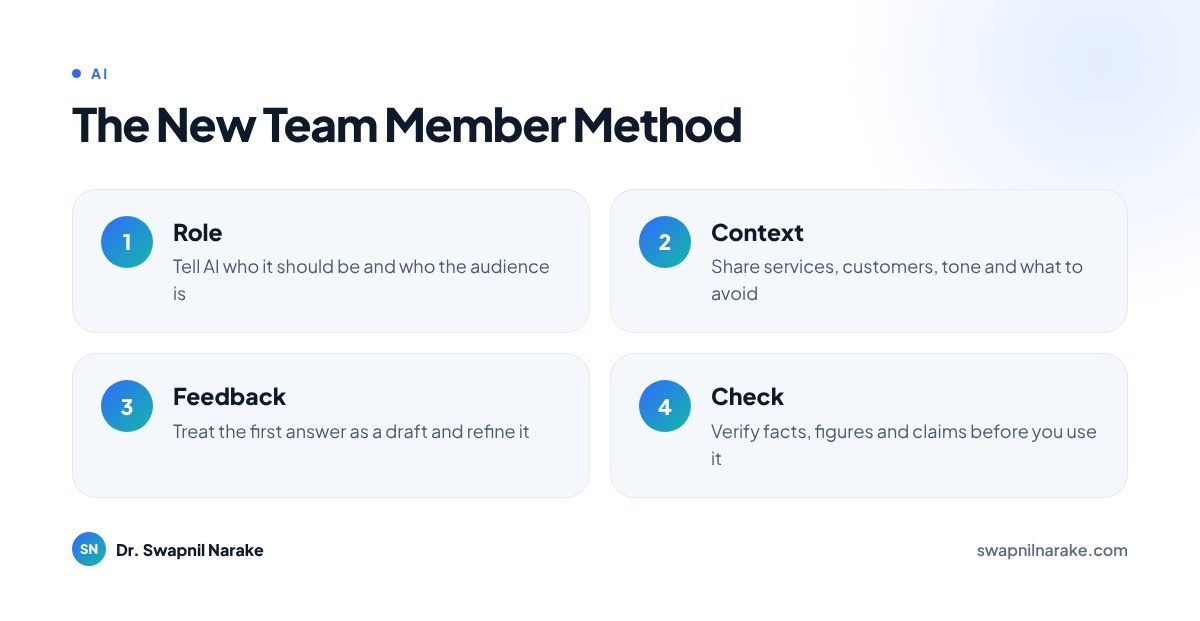
Step 1: Give AI a clear role
Start by telling AI who it should be for this task. “You are an experienced content writer for a dental clinic in Pune” produces a very different answer from “write something about teeth”. A role sets the tone, vocabulary and level of expertise. Be specific about the audience too: parents of Class 10 students, first-time GST filers or senior citizens with knee pain.
Step 2: Give it information about your business
This is the step most people skip. Share what makes you different: your services, location, price range, typical customer questions, past content that worked and the words your customers actually use. Mention what to avoid too, such as jargon or exaggerated claims. The more relevant context you give, the less AI has to guess.
A simple brief covers six points:
- Role: who AI should act as.
- Audience: who will read the output.
- Context: your business, offer and what makes you different.
- Task: exactly what you want produced.
- Format: length, tone, language and layout.
- Avoid: claims, words or topics that are off limits.
Step 3: Give feedback to improve the answer
Treat the first answer as a draft, not the final product. Tell AI precisely what to fix: “make it shorter”, “this sounds too formal for WhatsApp”, “add an example from a small town” or “the second point is wrong, our fee includes study material”. Two or three rounds of clear feedback usually turn a generic answer into something you would be happy to use.
Step 4: Check the final answer yourself
Never publish or send AI output without reading it carefully. Verify facts, figures, dates, legal or tax references and any promise made to a customer, using original sources. AI is the assistant; you are the editor.
A worked example: from one line to a usable draft
Here is how the four steps change the result for a typical small-business task: an electronics shop in Kolhapur that wants a WhatsApp message for its Diwali offer.
The weak request: “Write a Diwali offer message for my shop.” The result is a generic greeting full of exclamation marks that could come from any shop in India.
The proper brief:
You are a copywriter for a family-run electronics shop in Kolhapur. Our customers are local families, many buying on EMI. Write a WhatsApp broadcast message for our Diwali offer: exchange your old mixer-grinder and get a discount on a new one, valid until Bhaubeej. Keep it under 80 words, warm and simple, in English with a Marathi greeting. Do not use words like “lowest price ever” or make claims about other shops. End with our phone number and timings.
The feedback round: “Good. Make the first line about the exchange offer, not the greeting, and mention that free home delivery is available within the city.”
The final check: the owner confirms the offer dates, discount terms and phone number before sending. The whole process takes a few minutes longer than the one-line request, and the message actually sounds like his shop.
Examples from CA offices, coaching classes and clinics
The same method works across professions; only the checking step becomes stricter as the stakes rise.
A CA office
A chartered accountant can ask AI to act as a client-communication assistant and draft a plain-language reminder about upcoming filing deadlines for small traders. The checking step is non-negotiable: every due date and rule must be confirmed against official notifications, because dates and requirements change.
A coaching class
A coaching institute can give AI the role of an academic counsellor and ask for a parent-friendly explanation of a new batch, or twenty practice questions on a chapter at a stated difficulty level. Feedback might be “these are too easy for repeaters”. A teacher then solves or reviews every question before it reaches students.
A clinic
A clinic can use AI to draft patient-education posts, appointment reminders or answers to common questions about timings and procedures. Two cautions apply. Do not paste identifiable patient information into public AI tools, and do not let AI give diagnoses or promise outcomes. The doctor should review every health-related statement, keeping in mind the professional advertising guidelines that apply to medical practitioners. For more on this, see my guide to healthcare digital marketing and patient trust.
Common mistakes to avoid
Most disappointing AI results come from a handful of avoidable habits:
- Asking for statistics and publishing them unchecked: AI can produce convincing numbers with no real source.
- Cramming ten tasks into one request: one clear task per request gives better results.
- Skipping the format: without a stated length and tone, you get an essay when you wanted a WhatsApp message.
- Assuming it knows today’s news: some tools have limited or no access to current information, so confirm anything time-sensitive.
- Using AI to fake trust: generating fake reviews or testimonials is dishonest and can breach consumer protection rules.
The final decision and accountability stay with you
AI can draft, summarise and analyse, but it cannot take responsibility. If a wrong figure reaches a client or a misleading claim appears in an advertisement, customers will hold your business accountable, not the software.
That is why I keep repeating one line: AI will not replace people, but people who use AI well will get ahead of those who do not. Using AI well also means being careful with data. Treat client and patient details with the same confidentiality you expect from any staff member, and check whether a tool’s settings allow your inputs to be used for training.
Make AI part of your system, not a one-off experiment
AI delivers lasting value when it becomes part of a repeatable team process rather than an occasional experiment. Having trained more than 10,000 students, I see a consistent pattern: the people who get results from AI are not the most technical. They are the most systematic. My personal principle is Systems > Motivation, and it applies perfectly here.
- Save your best briefs: keep a shared document of role and context instructions that worked, so nobody starts from zero.
- Write a business profile: one paragraph on your services, audience and tone that anyone can paste into a new chat.
- Start with repeatable tasks: replies to common enquiries, captions, meeting summaries and first drafts of proposals.
To see how this fits into marketing, read my practical framework for AI in digital marketing, and see how small habits become a reliable process in building a marketing system.
Key takeaways
- One question and one answer rarely produce useful output; AI needs direction.
- Treat AI like a capable new team member who needs a proper briefing.
- Follow the four steps: role, business context, feedback and your own final check.
- Verify facts, figures and claims, especially in tax, education and healthcare.
- Keep accountability and sensitive data in your own hands.
- Save what works so AI becomes a team system.
FAQs
Which AI tool is best for a small business?
The method matters more than the tool. Most popular AI assistants draft and summarise well. Pick one, learn to brief it properly and review its privacy settings.
How long should my instructions to AI be?
Long enough to cover the role, audience, context, task, format and what to avoid. A clear paragraph usually beats a single line, and a saved business profile makes this quick.
Can I rely on AI for tax, legal or medical information?
Use it for drafts and explanations, never as the final authority. Confirm such information from official sources or a qualified professional before acting on it or sharing it.
How do I stop AI from making things up?
You cannot remove the risk completely, but you can reduce it. Give it the facts you want used, ask it to say when it is unsure, and verify every figure, date and name against an original source.
Will AI replace my staff?
In most small businesses, AI changes the work more than it removes the people. It speeds up drafting and summarising, while judgement, relationships and accountability stay with your team. Staff who learn to brief and check AI well become more valuable, not less.
To get real value from AI, stop expecting magic from a single question and start managing it like a smart new colleague: brief it well, guide it and own the final result. If you would like help building this approach into your team or your marketing, or would like me for a consultation, keynote or academic engagement, please get in touch.