Most advertising dashboards look healthy. Clicks are up, cost per lead is down, and the platform reports that the campaign is “performing”. Yet the sales team says the leads are poor and finance cannot find the revenue. If that sounds familiar, the problem is rarely the ads themselves. It is how we define and measure performance marketing ROI.
Having managed more than ₹2 Cr in performance marketing spend on Google Ads and Meta and generated more than 200K leads, I have learnt that the loudest platform numbers often matter least. Below, I cover the measures that connect spend to outcomes: lead quality, cost per qualified lead, CAC, LTV, attribution and the hand-off to sales, with a worked example and the mistakes to avoid.
What is performance marketing ROI?
Performance marketing ROI is the profit your paid campaigns generate compared with what they cost. It is measured in sales and margin, not in clicks or leads.
ROI = (Gross margin from attributed sales − Total marketing cost) ÷ Total marketing cost
It is worth separating ROI from ROAS (return on ad spend). ROAS divides revenue by ad spend, so it ignores product costs, team costs and discounts. A campaign can show a healthy ROAS and still lose money once margin is counted. Use ROAS as a quick platform-level signal, and ROI as the business-level verdict.
Why are platform metrics not performance marketing ROI?
Platform metrics measure activity, while ROI measures outcomes. The platforms optimise towards whatever signal you give them, so if that signal is a cheap form fill, you get cheap form fills, not necessarily customers.
Google Ads and Meta are excellent at optimising towards your chosen signal. If the signal is a form submission, the algorithm will find people who submit forms, whether or not they ever buy. That is not a flaw in the platform; it is a flaw in the brief. The same logic explains why boosting posts for engagement rarely produces sales, as I explain in why you should stop boosting posts.
Metrics such as CTR, CPC, CPM and even cost per lead are activity measures. They tell you the machine is running. ROI is an outcome measure. It tells you whether the machine is producing value. The gap between the two is where most budgets leak.
- Vanity layer: impressions, reach, clicks and CTR.
- Efficiency layer: CPC, cost per lead and conversion rate.
- Value layer: qualified leads, sales, revenue, margin and repeat business.
Real ROI lives in the value layer. The other two layers are diagnostic tools, not goals.
Why should you start with lead quality, not lead volume?
Because a cheap lead that never answers the phone is the most expensive lead you will ever buy. Before optimising anything, agree with sales on what a “qualified” lead means for your business.
Define qualification criteria together
Write a short, objective definition with your sales or call-centre head, for example:
- The contact details are valid and the person is reachable.
- The enquiry matches a product or service you actually offer.
- The person is in your serviceable location or target segment.
- There is a realistic intent or timeline to purchase.
Keep it simple enough to tag in one conversation.
Example: For a diagnostic centre, a qualified lead might be “reachable, within the city, asking about a test we offer, and wanting it within the next two weeks”. For a B2B software firm, it might be “decision-maker or influencer at a company of the right size, with a stated problem we solve”.
Feed quality back into the system
Push qualified and converted statuses back into your ad platforms through offline conversion imports or CRM integrations, so bidding algorithms learn from real outcomes rather than form fills.
What is cost per qualified lead?
Cost per qualified lead (CPQL) is your ad spend divided by the number of leads that meet your agreed qualification criteria. It is much harder to game than cost per lead (CPL), because it only counts leads with genuine sales potential.
Cost per qualified lead = Total ad spend ÷ Number of qualified leads
Reviewing CPQL by campaign, ad set, keyword and creative often reshuffles priorities. A campaign with a higher CPL may deliver far better-qualified leads and therefore a lower CPQL. Without this view, teams routinely pause their best campaigns and scale their weakest ones.
How do CAC and LTV show whether growth is sustainable?
Customer acquisition cost (CAC) shows what it costs to win a customer; customer lifetime value (LTV) shows what that customer is worth over time. Comparing the two tells you whether scaling spend will scale profit or losses.
Customer acquisition cost
CAC is the total cost of acquiring one paying customer. A blended CAC includes media, team or agency costs, tools, creative and sales costs. A paid-media CAC isolates the media portion. Never confuse the two in a budget discussion.
Lifetime value
LTV estimates the gross margin a customer contributes over the whole relationship, not just the first transaction. In businesses with repeat purchases, follow-up services or subscriptions, LTV can be many times the value of the first order.
Reading the ratio
The LTV to CAC ratio tells you whether growth is sustainable. If LTV comfortably exceeds CAC, you can afford to invest more aggressively in acquisition. If CAC is creeping towards LTV, scaling spend will simply scale losses. A ratio of about 3:1 is a widely quoted rule of thumb, but it comes mainly from subscription businesses; judge your own target against your margins and cash needs. Also watch the payback period, because cash flow matters as much as long-term value.
A worked example: why CPL can point the wrong way
A simple comparison shows how judging campaigns on cost per lead can reverse the right decision. The figures below are hypothetical, chosen only to illustrate the calculation for a coaching institute selling a course with an average gross margin of ₹8,000 per enrolment.
- Campaign A: ₹50,000 spend, 400 leads (CPL ₹125), 60 qualified (CPQL about ₹833), 10 enrolments (paid-media CAC ₹5,000).
- Campaign B: ₹50,000 spend, 200 leads (CPL ₹250), 100 qualified (CPQL ₹500), 20 enrolments (paid-media CAC ₹2,500).
On the dashboard, Campaign A looks twice as efficient because its CPL is half. On outcomes, the picture flips. Campaign A produces ₹80,000 in gross margin, an ROI of 60%. Campaign B produces ₹1,60,000, an ROI of 220%. A team managing on CPL would scale A and cut B, which is exactly the wrong way round.
Add LTV and the gap can widen further: if students who enrol through B tend to return for advanced courses, its true value is even higher than first-purchase figures suggest.
Which attribution model should you use?
Use one model consistently as your operating standard, understand its bias, and test it against reality from time to time. With enough data, data-driven attribution is usually a sensible default.
Very few customers click one ad and buy immediately. They watch a video, search a week later, read reviews, then call after a retargeting ad. Attribution is how you decide which touchpoints receive credit.
- Last-click: simple, but over-credits bottom-funnel search and retargeting.
- First-click: highlights discovery channels but ignores what closed the sale.
- Linear and time-decay: spread credit across touchpoints with different weightings.
- Data-driven: uses your own conversion paths to assign credit statistically, as offered in Google Analytics 4 and Google Ads when there is enough data.
No model is perfectly “true”. Sanity-check your chosen model periodically with geographic or time-based holdout tests. The real question is incrementality: the sales that would not have happened without the ad. Attribution also shapes how you compare channels; my guide to Meta Ads vs Google Ads covers how each platform tends to show up in the journey.
How do you connect ads to sales and call-centre outcomes?
You connect ads to sales by capturing source data with every lead, keeping all leads in one CRM, tagging outcomes and sending those outcomes back to the ad platforms. Without this loop, you only see half the journey.
In sectors such as healthcare, education and real estate, the sale happens on a call, in a WhatsApp chat or at a counter, not on the website. If measurement stops at the form, the most important part of the journey stays invisible.
Closing the loop usually requires five things:
- Consistent tracking parameters: UTM tags and click IDs captured with every lead.
- One CRM as the source of truth: every lead from every channel lands in one place.
- Call tracking: dedicated or dynamically inserted numbers so phone enquiries are tied to campaigns.
- Disposition tagging: agents record outcomes such as not reachable, not interested, appointment booked or converted.
- Offline conversion uploads: outcomes are sent back to Google Ads and Meta on a regular schedule.
This is why I treat automated lead workflows, WhatsApp bots and AI chatbots as part of performance marketing rather than an afterthought. Fast responses and accurate outcome tracking decide whether a paid click ever becomes revenue.
What is the ROI measurement ladder?
The ROI measurement ladder is a six-step audit: Track, Qualify, Connect, Calculate, Attribute, Optimise. Each rung must be solid before the next one means anything.
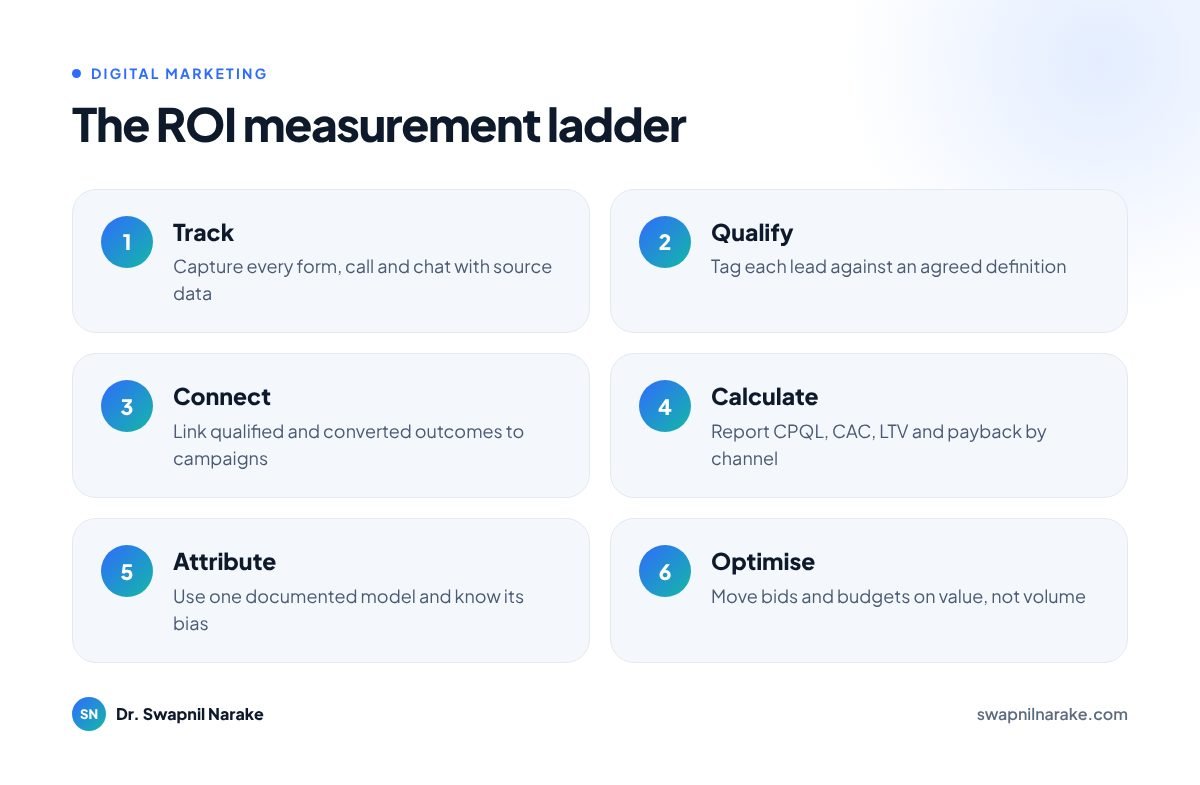
- Track: are all form fills, calls and chats captured with source data?
- Qualify: is every lead tagged against an agreed definition?
- Connect: are qualified and converted outcomes linked back to campaigns?
- Calculate: are CPQL, CAC, LTV and payback reported by channel?
- Attribute: is there a documented attribution model with known limitations?
- Optimise: are bids and budgets moved on value, not volume?
As I often say, Systems > Motivation: a well-built measurement system will outperform a motivated team working from misleading numbers.
Common mistakes to avoid
Most ROI problems come from measurement gaps rather than bad ads. These are the ones I see most often in account audits:
- Celebrating a falling CPL without checking whether qualified leads fell with it.
- Counting duplicate leads when the same person submits a form twice or calls and fills a form.
- Ignoring missed calls and slow replies. A lead that waits hours for a response often goes to a competitor.
- Changing too much at once. Editing bids, audiences and creatives together makes it impossible to know what worked.
- Judging too early. Long sales cycles need enough time for outcomes to come back before budgets are cut.
Key takeaways
- Clicks and cost per lead are diagnostics; revenue and margin are the goal.
- Agree a written definition of a qualified lead with your sales or call-centre team.
- Manage cost per qualified lead daily, and CAC, LTV and payback monthly.
- Pick one attribution model, know its bias and test incrementality periodically.
- Close the loop by sending offline outcomes back to Google Ads and Meta.
Measuring performance marketing ROI properly is less about new tools and more about discipline: clear definitions, connected data and honest reporting. Get those right and every rupee becomes easier to defend and to scale.
FAQs
What is a good performance marketing ROI?
There is no universal figure. It depends on your margins, lifetime value and payback needs. Judge ROI against your own unit economics, and track whether it improves over time rather than chasing an industry benchmark.
How is cost per qualified lead different from cost per lead?
Cost per lead counts every enquiry. Cost per qualified lead counts only those meeting your agreed criteria, so it reflects genuine sales potential. It is the better number for deciding which campaigns to scale.
What is the difference between ROI and ROAS?
ROAS is revenue divided by ad spend. ROI accounts for margin and all marketing costs, so it shows actual profit. A campaign can have a good ROAS and still lose money.
Which attribution model should I use?
With enough data, data-driven attribution is a balanced starting point. Document your choice, apply it consistently and validate it with holdout tests. Avoid switching models frequently, as it makes trends hard to compare.
How do I track leads that convert over the phone?
Use call tracking numbers and capture source data in your CRM. Have agents tag every outcome, then upload converted leads to Google Ads and Meta as offline conversions so bidding learns from real sales.
For consultation, keynotes or academic engagements on performance marketing ROI, feel free to get in touch.